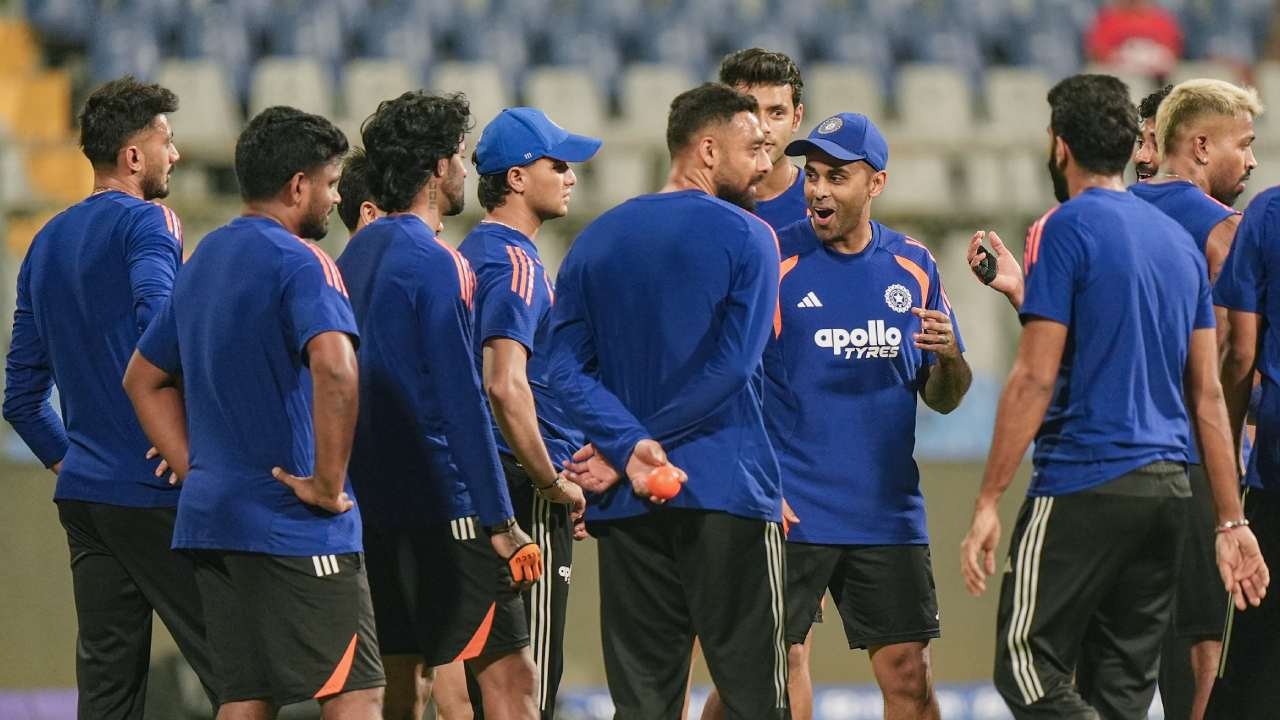
Mumbai’s Wankhede will witness a history-making event.The third consecutive T20 World Cup semifinal between India and England will take place at Mumbai’s Wankhede Stadium, where rivalry, history, and the pressure of making it to the final all come together.
India and England facing off in the semi-finals, Mumbai’s Wankhede will witness a history-making event.When England eliminated India from a World Cup semifinal nearly forty years ago, it silenced a crowded Wankhede Stadium. The men’s T20 World Cup semi-final between defending champions India and England takes place at the same location on Thursday night and Mumbai’s Wankhede will witness a history-making event. The victor will face New Zealand in the championship match.
Wankhede has seen numerous memorable events and is one of the rare locations where the poignant moments of Indian cricket have been flawlessly documented. Another Mumbai’s Wankhede will witness a history-making event. For millions of fans, two of the most memorable moments of the 2011 ODI World Cup are Gautam Gambhir’s powerful 97 and MS Dhoni’s famous six. But there have also been tragic events on the pitch. While MS Dhoni’s squad lost to the West Indies in the 2016 T20 World Cup semi-finals after nearly thirty years, Kapil Dev’s team failed to hold onto the title in the 1987 World Cup semifinals.
The Wankhede Stadium is predicted to become a cacophonous mess on Thursday night. A throng of passionate fans will assemble in the hopes that the stadium, which once produced some of Indian cricket’s biggest triumphs, will once again motivate the Indian squad.
England, a team that has proven a frequent foe in the T20 World Cup knockout stages, is in India’s way. Their most traumatic experience occurred in Adelaide in 2022. England secured a devastating ten-wicket victory by chasing down India’s 168 without losing a wicket.
India changed their T20 strategy as a result of the devastating loss in 2022.
The team’s leader at the time, Rohit Sharma, was candid about the necessity of change. India’s white-ball cricket system has long placed a strong emphasis on improvement, including building innings, evaluating large runs, and avoiding needless risks. However, the game was evolving quickly, and the Adelaide loss served as a reminder that contemporary Twenty20 cricket increasingly demonstrates speed, purpose, and bravery.
Since then, India has emerged as the standard for contemporary, fast-paced Twenty20 cricket. The squad has surpassed the audacious format to win the 2024 title under the leadership of Suryakumar Yadav and the direction of Gautam Gambhir. India’s bold new plan will be validated if they defeat England on Thursday.

England will pose a tough challenge to India. (PTI Photo)
Table of Contents
Indian team strategy
The starting lineup for India’s T20 World Cup semi-final matchup with England is unlikely to change significantly. On Thursday, the same players that faced the West Indies at Eden Gardens on Sunday are probably going to play at Mumbai’s Wankhede will witness a history-making event . However, because the opponent and surface have changed, Gautam Gambhir and Suryakumar Yadav might alter the bowling attack slightly. The Indian team is also worried about Abhishek Sharma’s performance.
After hitting 55 runs against Zimbabwe, Abhishek appeared to be getting back on track, but he faltered once more against the West Indies. In a crucial game like the semi-final, Gambhir is concerned about the left-handed opener. When they play England, will they select the starting lineup without him? Not likely. In the semifinal, the Indian team hopes to offer Abhishek another opportunity. Against England, Abhishek will be used with some risk. He will be introduced by Sanju Samson. The Kerala wicketkeeper should not be dropped after his outstanding innings of 97 runs against the West Indies.
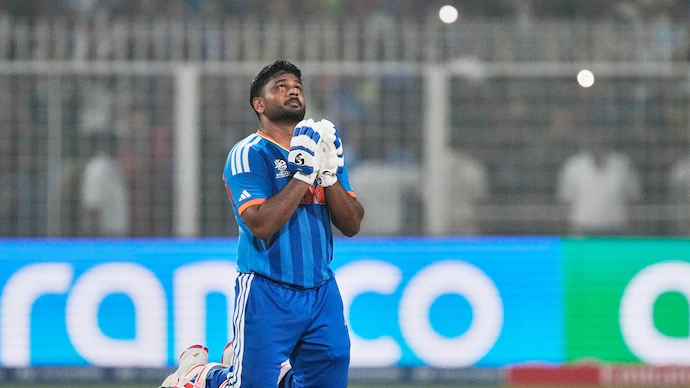
Samson guided India to a crucial win over West Indies. (PTI Photo)
ALSO READ : Eden’s 97 is Sanju’s career a turning point , ICC T20 rankings have become a turning point, jumps 25 places
In the batting order, Ishan Kishan will bat third. Despite not scoring many runs, the Jharkhand wicketkeeper is in form. He will undoubtedly participate in the semifinals as well. At number four will be Suryakumar Yadav. The captain’s batting order is clear. In the batting order, Tilak Verma will appear at number five. Against the West Indies, he performed admirably. If necessary, he can play off-spin.
Shivam Dubey will bat at number seven, and Hardik Pandya is probably going to bat at number six. The Mumbai cricket player is hitting runs fast with the bat at the finish despite not being able to rely on the ball. At number eight will be Axar Patel. Additionally, the vice captain will undoubtedly play against England.
Regarding Varun Chakravarty and Jasprit Bumrah’s performance, there is no doubt. After learning about the Wankhede pitch, the Indian camp will select the third player. The likelihood of Arshdeep Singh playing is higher. Kuldeep Yadav can replace him in the starting eleven at the last minute if the surface is extremely dry. Other than this, there is very little chance of anything changing.
Head-to-head: IND vs. ENG
In 29 Twenty20 international matches between India and England, India has prevailed 17 times to England’s 12.
India has won three of their five encounters in the T20 World Cup.
India and England facing off in the semi-finals, Mumbai’s Wankhede will witness a history-making event.Additionally, the two teams have faced off twice at the Wankhede Stadium, with India winning the most recent match by a commanding 150 runs in February 2025. Against England’s attack that evening, Abhishek Sharma lit up the ground with a scorching 135 off just 54 deliveries. In the days preceding this semi-final, it is reasonable to suppose that the youthful opener has replayed the highlights of that innings several times.
SPIN vs PACE IN MUMBAI
It’s interesting to note that during the competition, both fast bowlers and spinners have had similar success at this location, which deviates slightly from the typical pattern at Wankhede.
Pacers have claimed 1635 wickets in all T20 matches played at the venue, while spinners have claimed 781. However, the statistics have been much closer in this World Cup.
Pacers have taken 43 wickets at an average of 27 and an economy rate of 9.10, while spinners have taken 40 wickets at an average of 24.65 and an economy rate of 8.01.