

(From left) Rohit Poudel, Yuvraj Samra, Justin Muska and Scott Edwards. — File image.
little but not ‘weak’!.The attention has been drawn to the domination of weaker countries in the T20 World Cup. Australia was defeated by Zimbabwe. Italy, the Netherlands, and Nepal have demonstrated that they are not to be underestimated.
Sam Curran of England had the ball in his hand as he prepared.,little but not ‘weak’The excitement on Nepal’s Lokesh Bam’s face was obvious. Not everyone has the chance to write history in front of 30,000 of their fellow citizens at Wankhede Stadium. For a brief while, Nepal’s and Lokesh’s hopes were not realized that day. Brad Evans, however, did not mistake. As soon as he defeated Matthew Kuneman, his Zimbabwe created history.
little but not ‘weak’The T20 World Cup this year has demonstrated that in cricket’s shortest format, there is no such thing as a weak or vulnerable squad. The battle between David and Goliath is limited to words and actions. On their day, Davids can vanquish any Goliath. They can engage in eye-to-eye combat. Is it any surprise that Gerard Erasmus, the captain of Namibia, has called for the terms “member country” and “weak” to be eliminated from their names?
Table of Contents
The first week of the rule.
Countries said we are little but not ‘weak’ like Nepal, America, and the Netherlands have put up performances in the competition, which consists of ten member nations, that are sufficient to overcome their differences with the known as cricketing powerhouses. Nepal came so close to defeating England. India was under a lot of pressure from the United States. The Netherlands and Pakistan were separated by a single missed catch. Nobody realized the bombshell that was in store. After 19 years, Australia lost to Zimbabwe, making new history. Sikandar Raja stated after Zimbabwe’s triumph, “This time, we want everybody to talk about us. It only takes the ICC competition to transform lives. You may earn respect, money, and notoriety here. “This achievement is not a coincidence, but rather the outcome of adhering to a particular and methodical procedure,” stated Givemore Makoni, the nation’s board chief. Zimbabwe can now compete with the world’s finest thanks to specific investments in international cricket, which have also improved efficiency and fortified our infrastructure.

Netherlands cricket team. Photo: PTI.
Playing all over the world in a bid to establish one’s identity
Opportunities for tiny nations to compete with large nations were not previously established in this manner. They were not given the chance to confront one another in that manner, even in elite cricket. Opportunities have expanded significantly as a result of the T20 World Cup being contested every two years this country statement that we are little but not ‘weak’. An even greater part has been played by franchise cricket. Not other franchise league in the world is as prestigious as the Indian Premier League. Not every league features well-known cricket players. By participating in these leagues, cricket players from member nations have established themselves show his ability that Not ‘weak’ but little. For instance, a large number of cricket players from member nations participate in the Caribbean Premier League, Nepal Premier League, and American Major League Cricket. This has taught them how to bowl and bat under pressure. Wearing the national shirt on the big stage is now easier as a result. Sharadindu Mukherjee, a former cricket player for Bengal, has once again given the ICC credit. “The Indian board and the ICC also play a significant role in the growth of small teams,” he remarked. They are now receiving large sums of money from the ICC. Previously, these nations’ cricket players did not play year-round. However, they currently compete year-round in leagues from other nations. For instance, Nepali cricket players compete in the Delhi, Bihar, and Uttar Pradesh leagues.

Nepali supporters. Photo: PTI.
A squad of international cricket players
little but not ‘weak’.There are multiple foreign cricket players on the teams of the majority of the ten member nations. In other words, people who were born abroad. Cricket players from Bangladesh, Sri Lanka, Pakistan, and India make up the majority of them. There are more cricket players from Pakistan and India. Playing first-class cricket in their own nation has helped many Indian cricket players grow as individuals. However, they have established themselves abroad because they lack opportunities in their own nation. The most well-known of them are Sourav Netravalkar of the United States, Harmeet Singh, Dilpreet Bajwa of Canada, Navneet Dhaliwal, Ansh Patel, Jatinder Singh of Oman, Shoaib Khan of Amirshahir, Alishan Gharafu, Aryansh Sharma, and Jasprit Singh of Italy. In every game, they have given their all for their nation. such as Shubham Ranjan, an American who played for Mumbai alongside Suryakumar. Grant Stewart, an Italian, played cricket in England for the majority of his career. Alongside Faf du Plessis and AB de Villiers, Roelof van der Marwey of the Netherlands and Andreas Gauss of America played cricket.
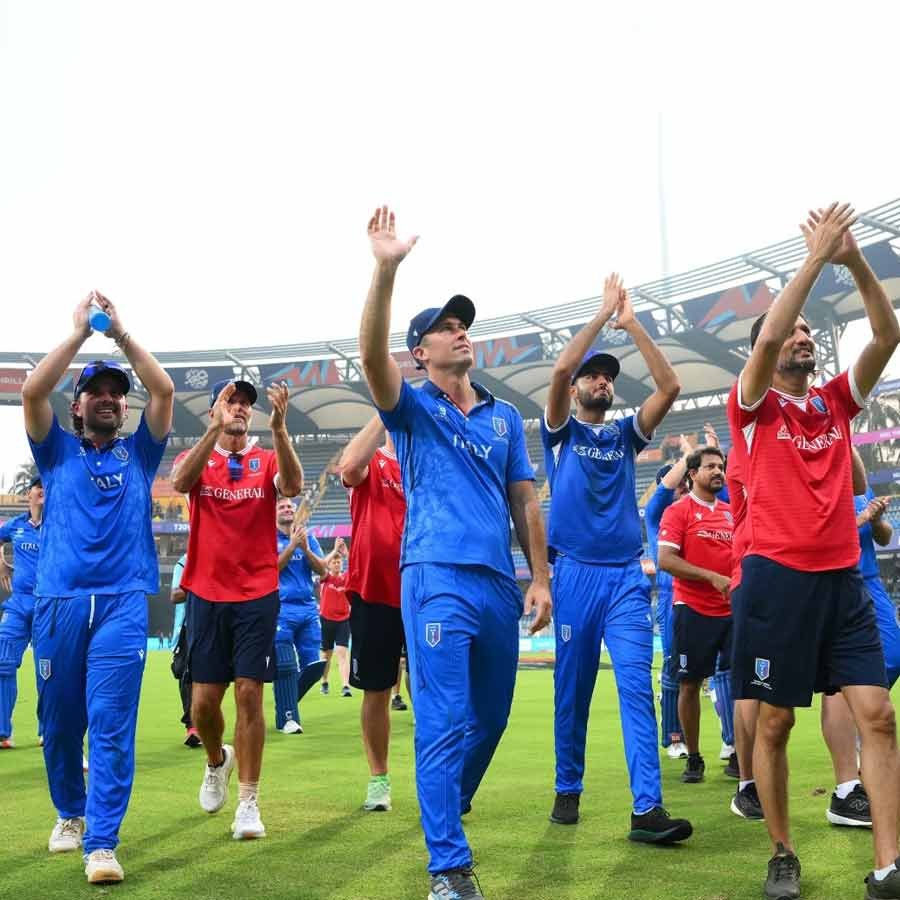
Italy cricket team. Photo: PTI.
A difficult battle during the qualifying round
Direct participation in the World Cup was made possible for full member nations. However, qualification gave member nations the chance to compete in the World Cup and said we areNot ‘weak’ but little. Scotland, for instance, was trounced by Italy. A lot of the qualifying matchups were intense and difficult. It enabled the players to perform at their highest level. They realized that a small error may cost them their steady income and their aspirations for the rest of their lives. This spirit of perseverance was also evident in the major event. Even after witnessing the great cricket players of the major nations, the players from the member nations are not giving up.
Some example
The Pakistan vs. America contest from the most recent T20 World Cup stands out as the most memorable. Pakistan scored 159/7 when they batted first. Monank Patel and Aaron Jones helped America score the same number of runs in response. The Super Over aim for Pakistan was 19. Salman Aghara was unable to accomplish it. Australia has previously lost to undersized teams. Afghanistan defeated them the last time. As was the case in Zimbabwe, Australia lost a number of wickets in rapid succession early on while chasing Afghanistan’s 148. Naveen-ul-Haq and Gulbadin Naib handed the Afghans the victory. In this World Cup, Namibia was unable to cause any incidents. But in the first game, they defeated Sri Lanka by 55 runs four years ago.
1 thought on “little but not ‘weak’! Italy, Nepal, and the Netherlands demonstrate why member nations dominate the Twenty20 World Cup.”