

Gyanesh Kumar — File photo.
According to the Election Commission, all posters, election hoardings, and advertisements must be taken down from all government ministries and buildings. It is forbidden for any political party or candidate to use government vehicles for election-related purposes. It was also stressed how important it is to strictly follow all electoral procedures.
In relation to the electoral code of conduct, the Election Commission has released eight more instructions. West Bengal, Assam, Kerala, Tamil Nadu, and the Union Territory of Puducherry are the four poll-bound states where these rules must be followed. The Model Code of Conduct (MCC) for elections must be strictly followed in these five areas.
Table of Contents
Commission Guidelines
The Election Commission has mandated that all posters, election hoardings, and advertisements be taken down from all government ministries and buildings. Government vehicles are not allowed to be used by any political party or candidate for election-related purposes. Additionally, the Commission has made it clear that public exchequer monies cannot be used to finance any form of electoral marketing. Directives have been sent to all banks, specifically telling them to keep a watchful eye on the transfer of substantial amounts of money.
Political parties have received a notice from the Election Commission stating that no gatherings or demonstrations may take place in front of a home without the homeowner’s consent. Additionally, any type of wall writing or the display of party flags need the homeowner’s consent.
A dedicated helpline number (1950) has been made available by the Election Commission for complaints about electoral rule infractions. The District Election Officers (DEOs) or Returning Officers (ROs) can be contacted at this number to file complaints. Additionally, anyone can use the “cVIGIL App” to access “ECINET” in order to register a complaint against any suspected violations of the Model Code of Conduct. In five states, the Commission is deploying more than 5,713 Flying Squads. Within 100 minutes of receiving a complaint, these teams must act. The Commission is also sending 5,200 Static Surveillance Teams to the states where voters will cast ballots in order to keep an eye on the general situation.
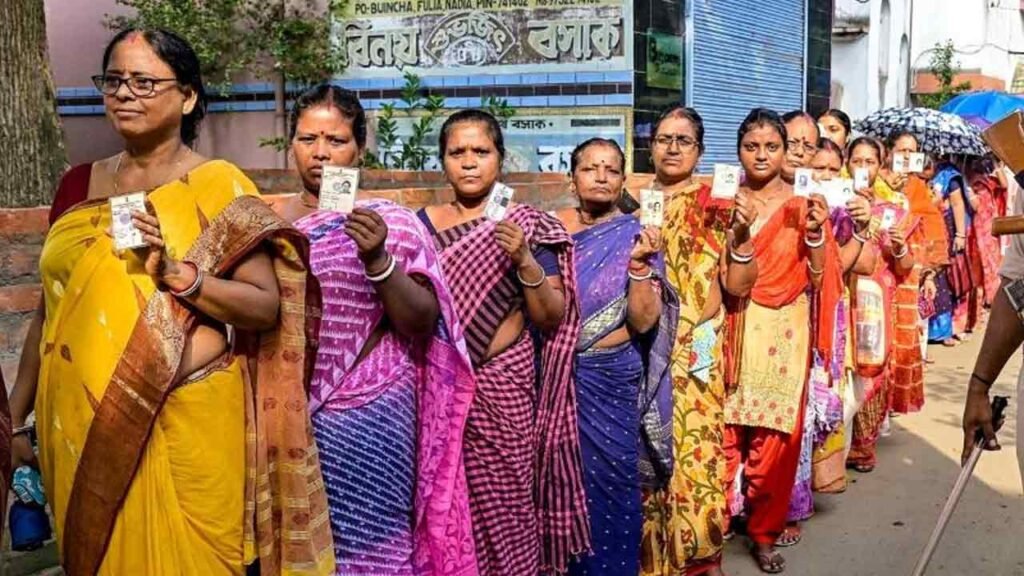
This time, the West Bengal Assembly elections are being held in two phases. Photo: PTI.
The administration has been instructed by the Election Commission to apply the Model Code of Conduct impartially. They have been told to make sure that every political party has equal possibilities. They have also been advised to keep an eye out for any abuse of official authority. Furthermore, according to the Commission, political parties must apply via the “Suvidha” portal on “ECINET” if they want to host a meeting at a certain location. The first party to submit an application will be granted permission to hold the meeting.
“Irregularities” in West Bengal Webcam Surveillance
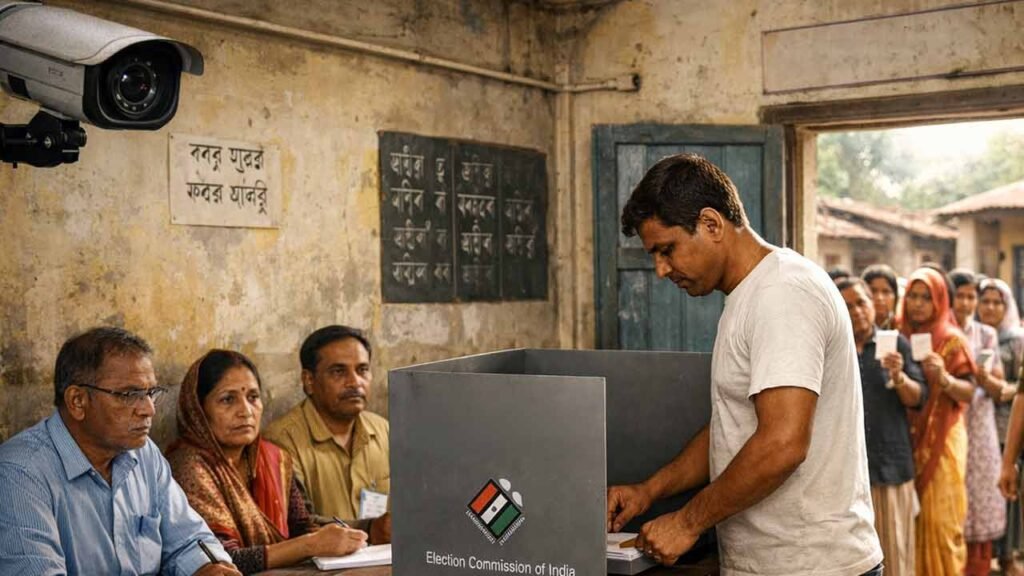
A polling station during an election. Image: Generated with AI assistance.
“Irregularities” in West Bengal Webcam Monitoring: “Nothing Recorded” in Several Booths in 2021 and 2024 The Election Commission now selects an agency from outside the state.
According to the Election Commission, there were “irregularities” with the webcams placed inside voting places during the most recent Assembly and Lok Sabha elections. They assert that many cameras failed to capture any video at all during these two elections. As a result, the Commission has ended its long-standing agreement with the organization that was previously in charge of this function. The Election Commission is replacing it by hiring three companies from outside the state to provide the webcams.
Examining the footage from the cameras used in the previous two elections revealed this disparity. As a result, it was decided to switch webcam providers. Recordings from the 2021 Assembly elections and the 2024 Lok Sabha elections were being examined, according to Election Commission sources. About 30% of the cameras were found to have no recordings at all throughout this assessment. Additionally, only the first and last 30 minutes of the polling time were recorded in another 30% of the cameras; the remainder of the voting process was not covered.
As soon as the issue was discovered, a bid was made to assign the task to a different organization. The Commission has chosen three non-state agencies through this procurement. For the next Assembly elections, the Election Commission will get webcams from these three out-of-state organizations.
The West Bengal Assembly election dates were released on Sunday by the Election Commission. There will be two stages to the West Bengal Assembly elections in 2026. The first phase of voting is scheduled for April 23, while the second phase is scheduled for April 29. 152 seats will be polled in the first phase, while 142 seats will be polled in the second. On May 4, the votes will be tallied.