The Supreme Court asserts that an accurate voter list is essential to India’s democracy. Elections cannot be fair if the voter list includes names of deceased persons, numerous entries for the same person, or names of people who have moved.
Table of Contents
Supreme Court Verdict
The Special Intensive Revision (SIR) has been upheld by the Supreme Court. The Election Commission has the statutory right to carry out these changes, according to the ruling of the Supreme Court. A panel made up of Chief Justice Surya Kant, Justice Joymalya Bagchi, and Justice Vipul Manubhai Pancholi confirmed in its ruling on Wednesday that the Commission had the authority to create an open voter list. Removing the names of ineligible voters from the list is not illegal, and they have the power to confirm the voter rolls. The Supreme Court additionally declared that the Commission has the right to confirm voters’ citizenship. Legal experts pointed up that this decision, which resulted from a Bihar dispute involving the constitutionality of the SIR, will be applicable nationwide.
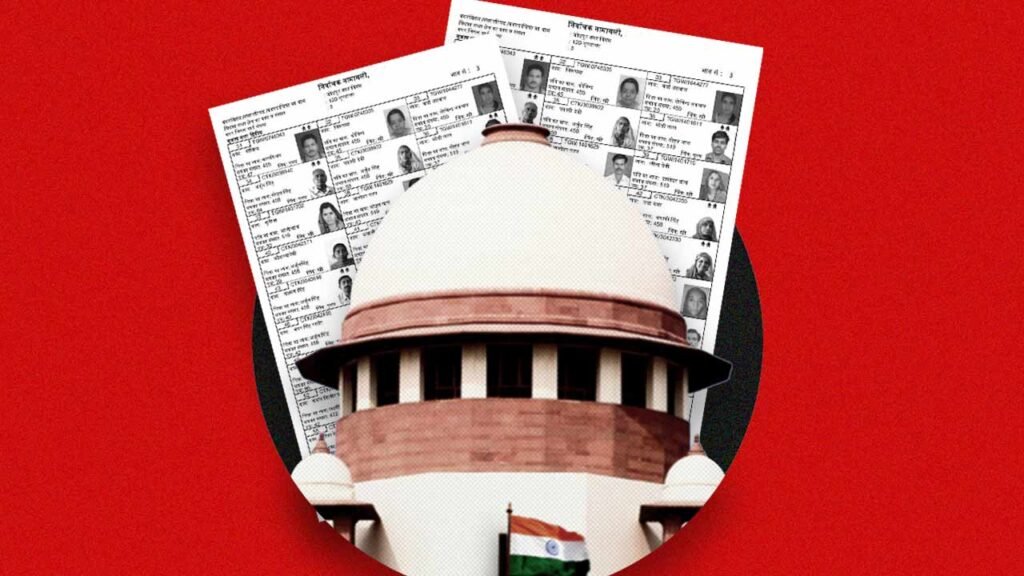
Graphic: Anandabazar.com
In order to correct the voter lists, the Commission made the decision to carry out a nationwide Special Intensive Revision (SIR). This exercise started last year, starting in Bihar. The Commission started a comprehensive, phased overhaul of the nation’s voter rolls. An SIR was also carried out in West Bengal prior to the assembly elections in five states. The Supreme Court received a number of Public Interest Litigations (PILs) against the SIR’s rules and regulations. The Commission’s jurisdiction to carry out such a SIR was also questioned. These cases’ proceedings came to an end in January of last year. Up until recently, the verdict had not been announced. The Chief Justice’s bench issued the ruling on Wednesday.
The Commission’s action was declared to be lawful by the Supreme Court. It didn’t use its authority arbitrarily. The Commission is empowered by the Constitution to ensure that the voter list is accurate. The Supreme Court asserts that an accurate voter list is essential to India’s democracy. Free and fair elections cannot be guaranteed if the voter list includes names of deceased people, duplicate registrations for the same person, or names of people who have moved. The Commission is responsible for maintaining the voter list’s accuracy and cleanliness as well as preventing ineligible people from being added.
Eleven documents for the SIR in Bihar were accepted by the Commission. In the lawsuit, it was questioned why those 11 specific documents were chosen. Does the Commission have the power to determine which papers are acceptable? The Supreme Court responded by stating that the Commission has a constitutional obligation to create and update voter lists. As a result, it has the power to decide what kinds of documents are needed for verification. This time, more documents have been accepted than in 2003.
SIR in Bihar
Bihar underwent its most recent extensive overhaul in 2003. Given the substantial amount of time that has passed since then, the Apex Court noted that carrying out such an exercise today cannot be considered an unjustified violation of democratic rights. The Commission’s conduct is not irrational, according to the Supreme Court. Over the previous 22 years, there had been no such modification, which had led to significant irregularities in the voter records. The Court did accept, nevertheless, that many people have experienced difficulties as a result of this process.
According to the ruling, it is typically assumed that a person is a legitimate voter if their name appears on a prior voter list, but this does not mean that their ability to vote can never be confirmed in the future. The voter list may be reexamined if necessary; otherwise, instances of fraudulent voting could never be found and corrected.
According to the Supreme Court, each voter was given a chance to make their case before being taken off the voter list in accordance with the law. The Court noted that the Commission had given opportunity for hearings and to file objections before deleting anyone from the voter list.
The Election Commission may perform a partial citizenship check, according to the Supreme Court. The Commission may, first and foremost, determine whether a person is an Indian citizen and eligible to vote. However, the Commission’s power is still limited to issues pertaining to voting rights and inclusion in the electoral roll. A person’s name being removed by the Commission does not automatically indicate that they are a foreign national. The Central Government’s appointed authorities have the last say over citizenship.