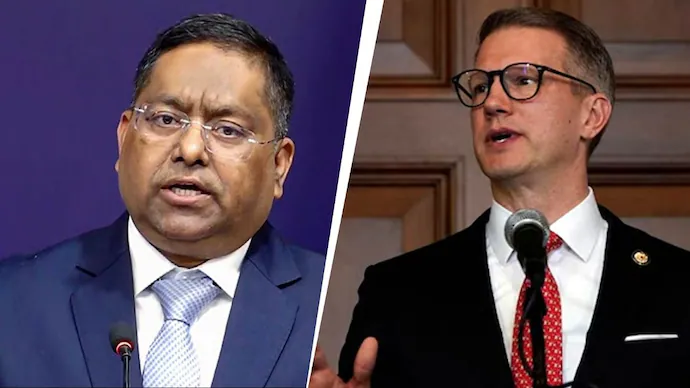
The US Congressman Riley Moore’s critique of the proposed FCRA Amendment Bill has been vehemently denounced by India’s Ministry of External Affairs. The Ministry referred to the issue as an internal Indian problem and pointed out that the US likewise has laws governing foreign donations. According to the federal government, the change intends to maintain the religious character of places of worship while strengthening monitoring of them.
The Bill seeks to empower a government-designated authority to manage the assets and foreign contributions of NGOs whose FCRA registration has been cancelled. (File Photo: ITG)
Table of Contents
The amendments could put control of churches in the hands of the government. Moore’s complaint
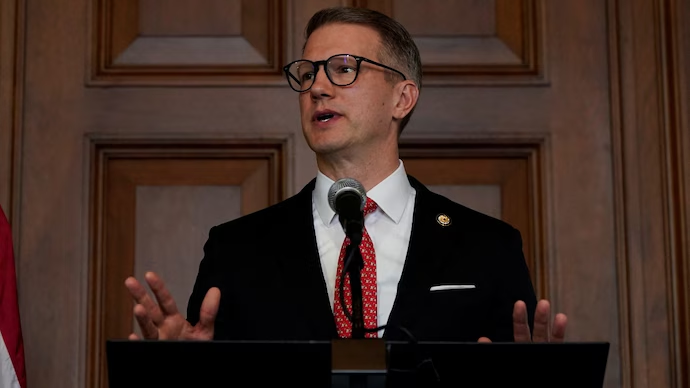
The US Congressman referred to the long history of Christianity in India before raising concerns over the proposed amendments. (File Photo: Reuters)
Moore asserted in a statement on August 4 that if churches and religious charitable organizations’ registrations under the Foreign Contribution (Regulation) Act (FCRA) were revoked or not renewed, the Indian government might seize control of them under the proposed modifications.
He encouraged the Indian government to reevaluate the draft regulation, arguing that it would have a substantial impact on Christian organizations.
The current “Foreign Contribution (Regulation) Act, 2010,” which regulates the acceptance and use of foreign contributions by individuals, associations, and non-governmental organizations (NGOs) in India, is to be amended by the proposed “Foreign Contribution (Regulation) Amendment Bill, 2026.”
The FCRA’s goal is to prevent foreign funding from having a negative impact on the nation’s integrity, security, sovereignty, public interest, or democratic institutions.
According to the proposed amendment, a government-designated authority will have the power to temporarily manage an organization’s foreign donations and associated assets in the event that its FCRA registration is canceled, surrendered, or not renewed.
The bill also mandates that when administering the assets of places of worship or religious organizations, the relevant authorities shall maintain the religious character of these establishments.
According to the Central Government, the proposed modifications are intended to guaranty accountability, openness, and appropriate management of organizations that accept foreign funding—especially when an organization is no longer qualified to receive international donations.
WHAT THE FCRA BILL PROPOSES
The “Foreign Contribution (Regulation) Act (FCRA), 2010,” which regulates how non-governmental organizations, charity trusts, educational institutions, religious groups, and other associations accept and use foreign contributions, is the subject of the proposed legislation. Before receiving foreign contributions, organizations must register with the Ministry of Home Affairs in accordance with current legislation. This registration must be renewed every five years.
As of July 15, 2026, there were 14,449 active FCRA registrations in India, according to the background material that goes with the law. In addition, 15,212 registrations had expired and 22,498 had been canceled. Organizations registered under this Act received ₹55,741 crore in foreign contributions between 2019 and 2022.
The Central Government’s creation of a “Designated Authority” is one of the most important suggestions. If an organization’s FCRA registration is canceled, voluntarily relinquished, or not renewed, this authority would have the ability to assume administration of foreign donations and assets made with such funds.
The measure also suggests a requirement for the minimal amount of money needed to renew registration. Organizations may no longer be eligible for renewal if they have used or received foreign grants totaling less than Tk 10 lakh during the previous two fiscal years.
severe limitations on the transfer of foreign donations to other organizations, severe deadlines for receiving and using funds from overseas, and increased requirements to publish information about projects, activities, websites, and social media accounts are some of the additional provisions.
CHANGES MADE TO PROTECT ASSETS: GOVT
The administration claims that these revisions are intended to protect government assets acquired thru foreign contributions while guaranteeing that continuing philanthropic endeavors are carried out in accordance with the law.
However, opponents of the proposed legislation have voiced concerns about the extent of government supervision, sparking discussion at the national and international levels.
The MEA’s answer, which reiterates that legislative decisions are matters of domestic policy and should be evaluated within India’s constitutional and legal framework, represents India’s first formal response to Moore’s critique.
The goal of the Bill, according to Minister of State for Home Affairs Nityanand Rai, is to make the use of foreign contributions “more transparent and accountable.” Additionally, he stated that organizations that uphold India’s integrity and sovereignty would not encounter needless obstacles, while those who violate the law or the country’s interests will suffer consequences.
In an effort to assuage organizations voicing concerns, Union Minister Kiren Rijiju stated that the government will clear up any misunderstandings regarding the Bill and that legitimate institutions working for the nation’s welfare would not be disrupted. The Ministry of Home Affairs has insisted that the changes are meant to increase accountability in foreign funding and fill operational shortcomings in the current legislation, according to the paper.